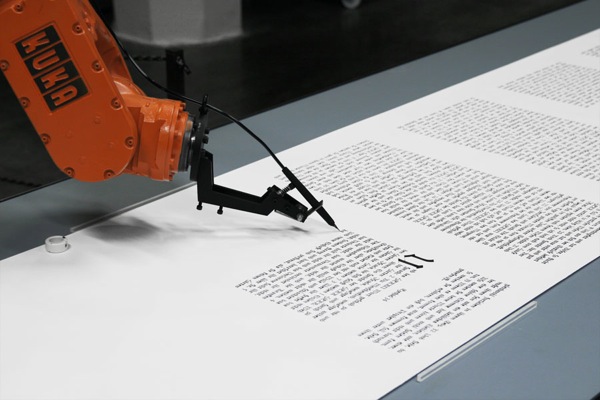
Robotlab, ‘The Bible scribe’ (2007)
The installation ‘bios [bible]’ consists of an industrial robot, that writes down the bible on rolls of paper. The machine draws the calligraphic lines with high precision. Like a monk in the scriptorium it recreates the text step by step.
Starting with the old testament and the books of Moses, ‘bios [bible]’ produces the whole book within seven months continuously. All 66 books of the bible are written on rolls and then retained and presented in the library of the installation.
(Robotlab is Matthias Gommel, Martina Haitz and Jan Zappe)
By mh
|
Posted in Composition
|
Also tagged action, bible, calligraphy, copy, DIY, fuckem, Jan Zappe, light, machine, Martina Haitz, Matthias Gommel, mechanical sculpture, monk, new, old, repeat, robot, robotlab, romance, scribe, scripture, testament, text
|
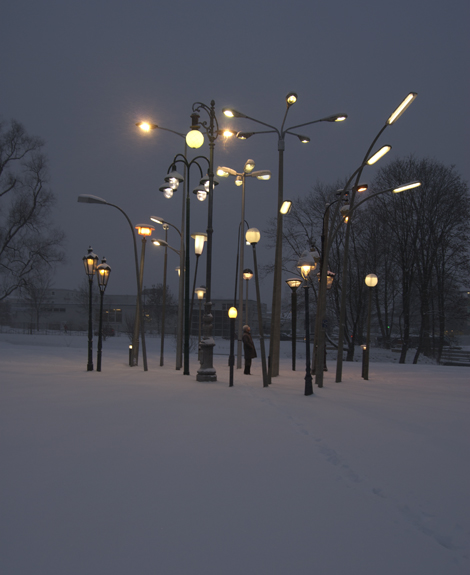
Sonja Vordermaier, ‘Streetlampforest’ (2010)
‘Streetlampforest’ is a collection of 30 european streetlamps from different origins and times (Amsterdam, Berlin, Erfurt, Leipzig, Glasgow, Innsbruck, Milano, Hamburg, Prag, Cagnes-sur-mer (France), Sarajevo, Stuttgart, Belgrade, Lippstadt, Munich, Sofia, Trieste,Wolfsburg and Vienna).
By mh
|
Posted in Composition
|
Also tagged amsterdam, Belgrade, berlin, Cagnes-sur-mer (France), collection, DIY, Erfurt, forest, fun, glasgow, Hamburg, hictorical, history, Innsbruck, lamp, leipzig, light, Lippstadt, Milano, munich, Prag, public art, romance, Sarajevo, Sofia, sonja vordermaier, street view, streetlampforest, streetlamps, Stuttgart, Trieste, vienna, Wolfsburg
|
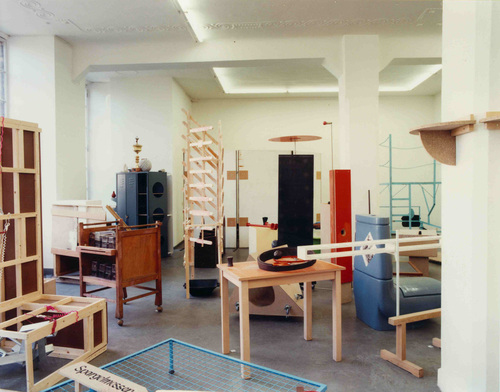
Martin Kippenberger, ‘Peter’
The idea of the ‘Peter’ sculpture installation was that all of these sculptures would be clustered together as you see them here in a way that they’re getting into eachother’s space and they make looking at any one sculpture impossible without the interference of all the others. The sculptures are not made by Kippenberger himself, they’re made for him by his assistant Michael Krebber, an artist in his own right.
‘Peter’ was a word that Kippenberger liked to use a lot in a very general way, almost like we now would say ‘whatever’. But it also had a punning aspect in which St. Petersburg was where the Hermitage museum was, and where one could find displayed hundreds of works of art in closed configurations on the walls as opposed to the isolation that we think of in modern western museums.
By mh
|
Posted in Composition
|
Also tagged action, appropriation, cluster, DIY, fuckem, fun, hermitage, joke, light, Martin Kippenberger, michael krebber, museum, peter, problem, sculpture, st petersburg, the wild, unknown, wall
|
By mh
|
Posted in Composition
|
Also tagged action, advertising, critique, DIY, famous people, lonely, lost, muur, public art, robert montgomery, romance, spectacle, text, unknown, wall
|

Michael Asher, ‘Think small’ (2010)
Asher’s piece is a reproduction of a 1959 print advertisement designed by Doyle, Dane, and Bernbach for the marketing of Volkswagen in the United States. “Think small” was the tagline in the ad and it became the concept of the campaign. Asher’s piece performs a kind of time travel, stretching back a half a century and replaying a historical campaign for our present consideration. When the “Think small” ads came out, America was firmly committed to a post-war economy perpetuated by the rapid growth of consumerism. Going against that grain, the “Think small” message encouraged investment in a reliable, affordable car rather than an oversized, flashy one. Visually and linguistically, the message of the campaign was to consume less, not more. Yet the ad’s critique of big consumerism performed well for corporate capitalism: many cars were sold, and the ad itself is credited with creating a sea change in the way advertising is created.
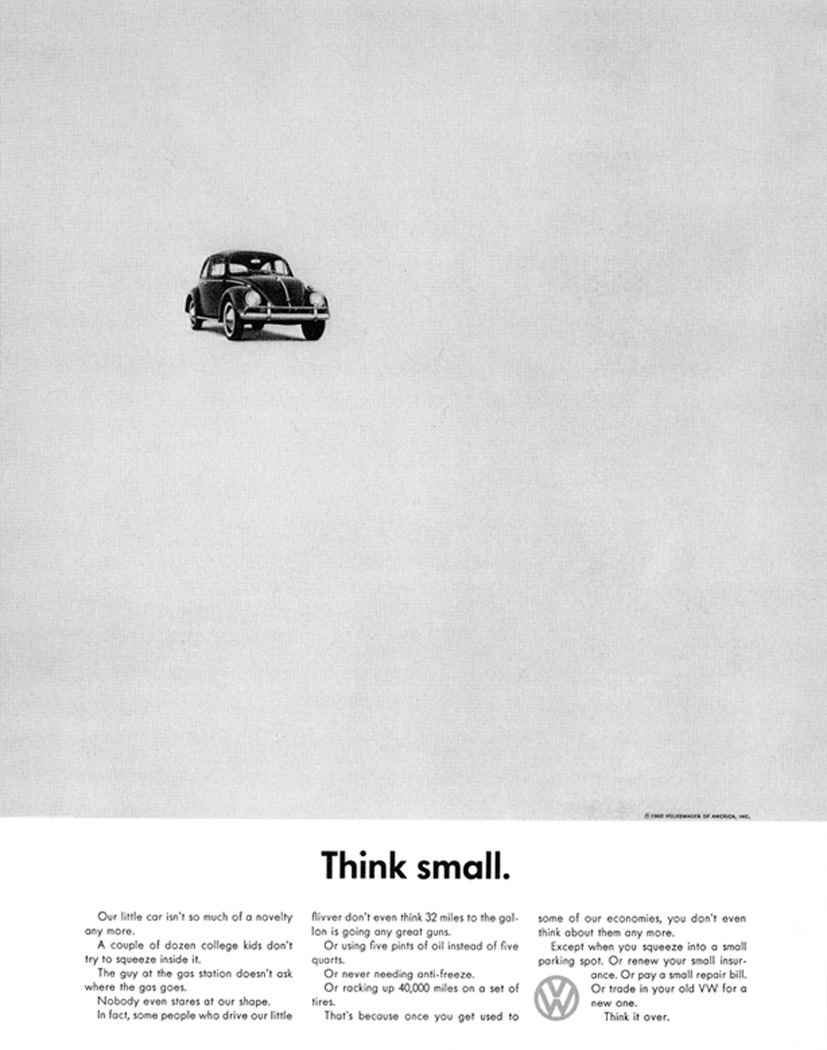
(the original ad – right-click and ‘view image’ for enlarging)
By mh
|
Posted in Composition
|
Also tagged action, ad, advertisement, advertising, billboard, car, consume, consumerism, critique, economics, fuckem, los angeles, mak, michael asher, public art, sign, size, text, think small, volkswagen, welfare
|
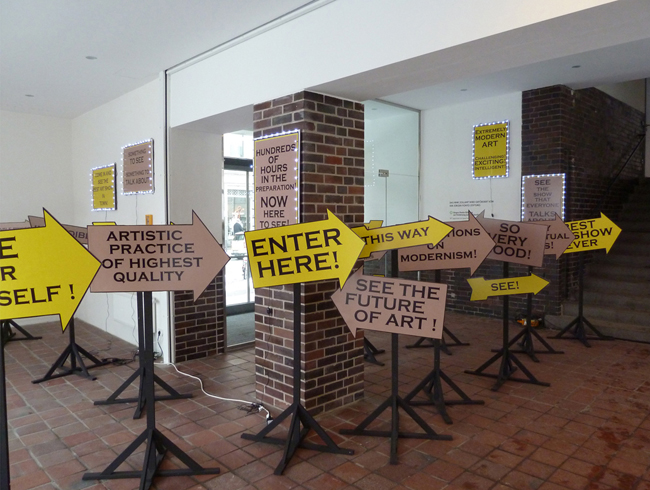
Claus Richter, ‘Great expectations’ (2010)
By mh
|
Posted in Abstraction
|
Also tagged Art, artist, claus richter, DIY, fuckem, fun, future, great expectations, humor, joke, sculpture, signs, text
|
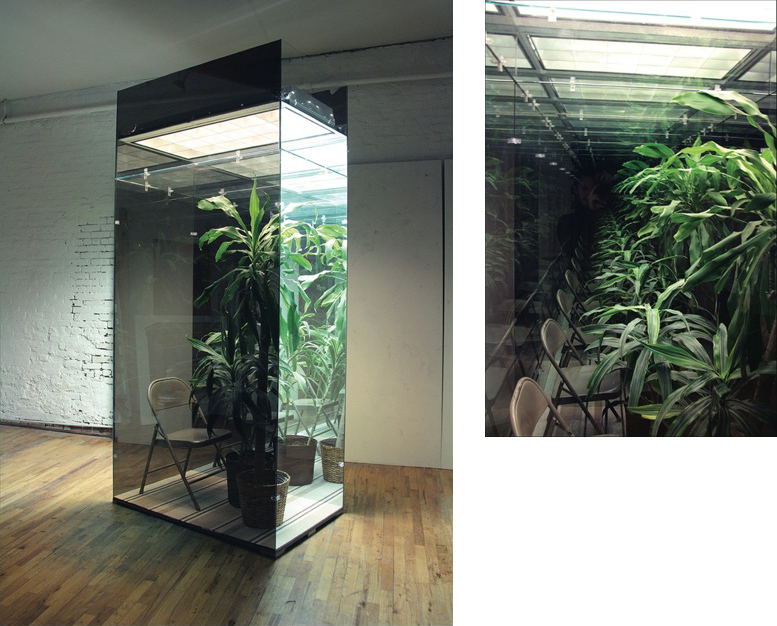
‘Plants have no backs’ (2008) and
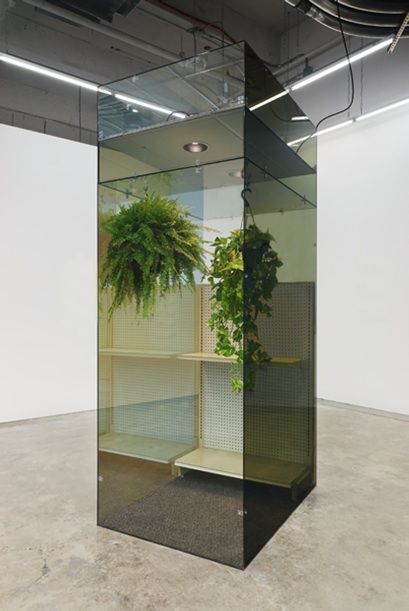
‘You can’t stop the hands of time, man’ (2008) by Ethan Breckenridge
By mh
|
Posted in Composition
|
Also tagged box, chair, collection, conceptual sculpture, confined, enclosed, ethan breckenridge, fuckem, glass, hands, light, mirror, nature, plants, sculpture, space, time, unknown, waiting room
|
By mh
|
Posted in Abstraction
|
Also tagged bingo, corner, DIY, gordon matta-clark, house, inside, muur, outside, roof, room, sculpture, the wild, trash, unknown, wall
|
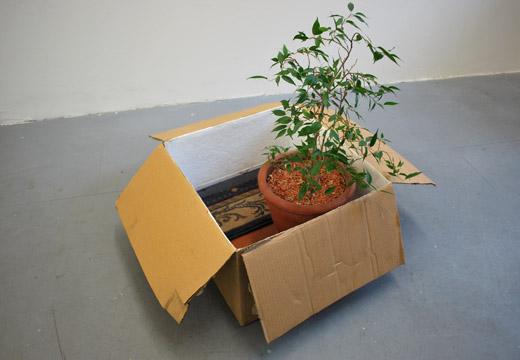

Untitled (2010), by Adrian Lohmüller
By mh
|
Posted in Composition
|
Also tagged adrian lohmüller, box, carpet, DIY, floor, Gamma, house, living, lohmueller, muur, nature, plant, romance, room, rug, sculpture, the wild, trash, unknown, wall
|

Timm Ulrichs
Timm Ulrichs, ‘Selbstausstellung’ (‘Exhibition of the self’) (1961)