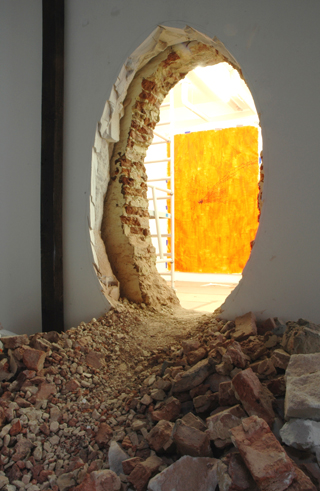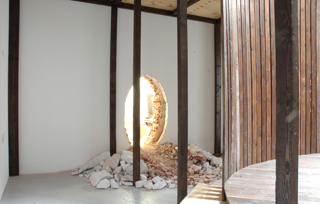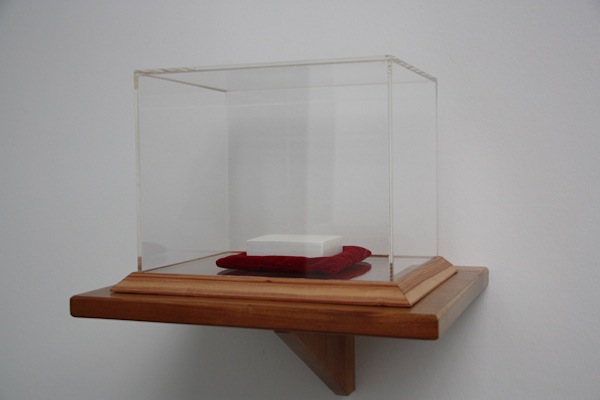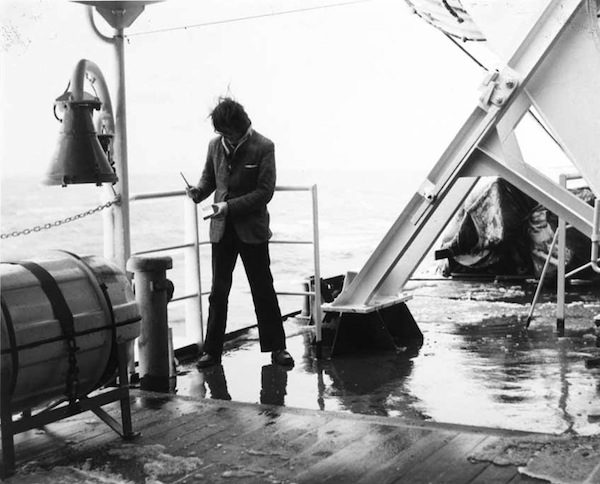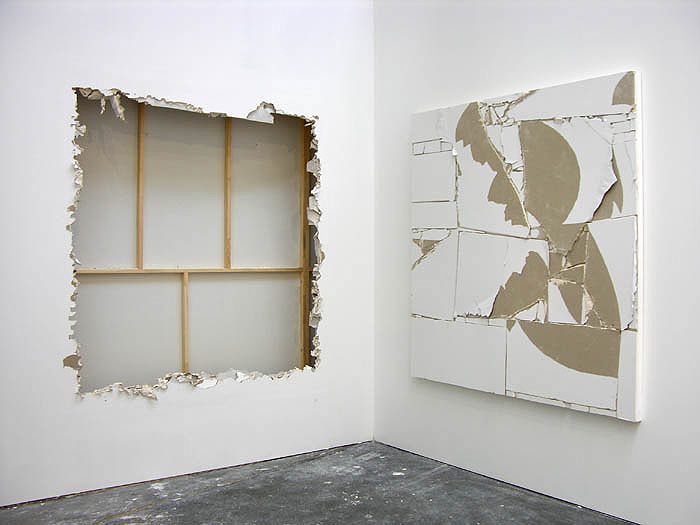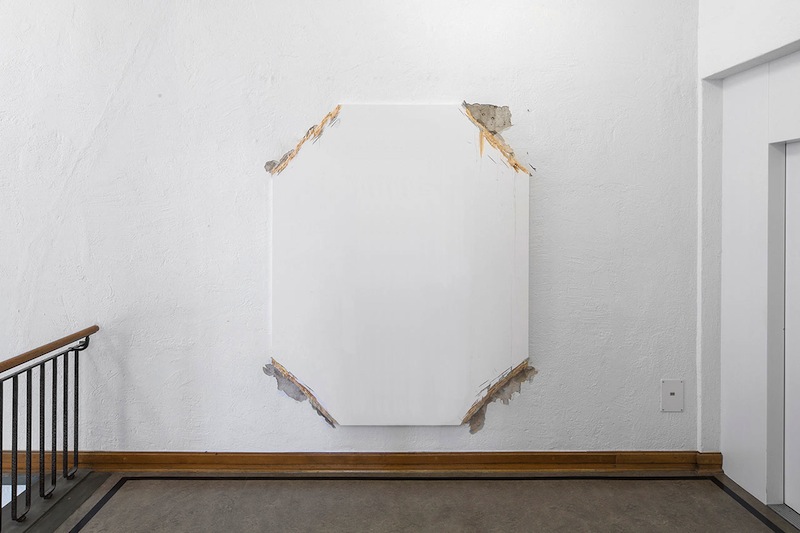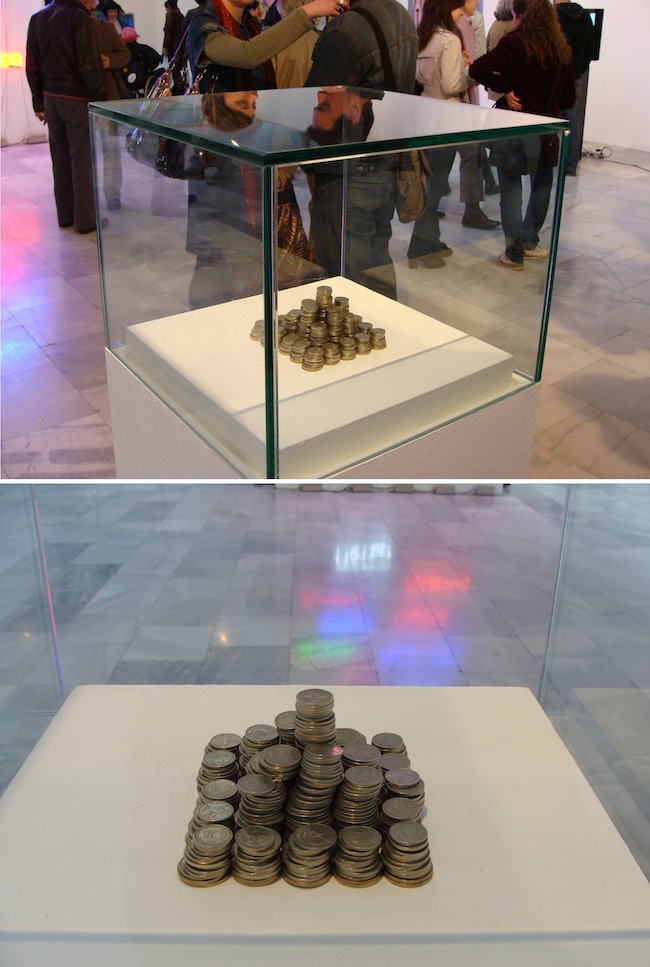
Ryan Siegan-Smith, ‘I don’t want to make a book’ (2007)
Not a book.

Jon Sasaki, ‘Flyguy triggering his own motion sensor’ (2010)
A flyguy (one of the familiar dancing inflatables that wave people into carwashes and fast food restaurants) has been moved into the gallery and hooked up to a motion sensor.

Oskar Dawicki, ‘I’m sorry’ (2010)
Live in front of the audience Dawicki reads a text explaining he’s sorry for the failed performance he’s giving. Finally, to make up for wasting the audience’s time and the curator’s chance of putting on a good show, he hands out sweets while a taperecorder plays the sound of him crying and once more apologizing.
A performance seen in Rotterdam during Witte de With’s performance cycle ‘Let us compare mythologies’. Pictures by Peter Rakossy.


More fine work by Dawicki downstairs….

Tue Greenfort, ‘Bio-Wurstwolke – After Dieter Roth 1969′ (2007)

‘Daimlerstraße 38′ (2001)
The animals were allured by a sausage. When the fox bit in the bait, it activated the camera connected by a cord with the sausage. One week later the animals had learned to eat the sausage without being photographed.
More more more

I saw Sexy Neighbors play live at The Charleston, NY, last Monday.
Below are three songs from their album ‘Dream Out’, which is currently growing on me…
Check them out!

Seen last Friday at Gregor Podnar in Berlin; Ariel Schlesinger’s solo show called ‘Reverse engineering’. Although not many works and not all of them as good; a nice show, with quite some energy!

Goshka Macuga, ‘The nature of the beast’ (2009)
Macuga was commisioned to make new work by the Whitechapel Gallery in London, where Picasso’s ‘Guernica’ had once been exhibited. Inspired by this historic fact, Macuga made a replica of the Guernica tapestry that Nelson Rockefeller commisioned in 1955. Some thirty years later this was lent to the United Nations Headquarters in New York where it has hung ever since outside the Security Council. Offered as a deterrent to war, in 2003 the tapestry was covered by a blue curtain in front of which Colin Powell delivered his fateful speech on weapons of mass destruction in Iraq.
Macuga’s installation ‘The nature of the beast’ in the Whitechapel Gallery consisted of the Guernica’s replica, as well as a round meeting table (a symbol of democracy) in front of it. The room had been designed to accommodate meetings, discussions and debates around the central table, with Guernica once again as a backdrop. Groups were invited to organise these events free of charge during opening hours.
Kenneth Anger, ‘Invocation of my demon brother’ (1969)
In 1967, the footage for Anger’s Lucifer Rising was allegedly stolen by Anger’s “Lucifer”, Bobby Beausoleil, who was later convicted for his participation in the Manson murders (Beausoleil denies stealing the footage to this day). Anger went into a deep depression and publicly renounced filmmaking via a full-page “In Memoriam” in The Village Voice. He later moved to London and met up with Mick Jagger and the Stones. By this time, Anger had begun editing two other versions of what was to be Lucifer Rising, although by the final edit it had taken on a very different form, which led to the incarnation of Invocation, a mind-bending collage of sonic terror and subversion and fast paced ritual ambiance which found the union of the circle and the swastika, a swirling power source of solar energy. Mick Jagger contributed a suitably eerie soundtrack with a newly acquired synthesizer.
It is Anger’s most metaphysical film: here he eschews literal connections, makes the images jar against one another, and does not create a center of gravity though which the collage is to be interpreted, as the images of Christ could be interpreted through the actions of the motorcyclists in Scorpio or as the images of Crowley could be interpreted through the ritual of Inauguration. Thus deprived of a center of gravity,the very image has equal weight in the film, and more than ever before in an Anger film, the burden of synthesis falls upon the viewer. The most demonic of Anger’s films, as well as the most fast moving.

Kenneth Anger (born Kenneth Wilbur Anglemeyer February 3, 1927) is an American underground avant-garde film-maker and author. His short films, which he has been producing since 1937, have variously merged surrealism with homoerotica and the occult. Whilst he has produced almost forty short films in his lifetime, only six of these have received distribution, and have come to be referred to as the “Magick Lantern Cycle”. He has been described as “one of America’s first openly gay filmmakers, and certainly the first whose work addressed homosexuality in an undisguised, self-implicating manner”, and some of his homoerotic works, such as Fireworks (1947) and Scorpio Rising (1964), were produced prior to the legalisation of homosexuality in the United States.

Also: In the next weeks pietmondriaan.com will have an irregular connection with China.
Space: Expo ‘Also Space’ (1-16 may) at C-Space in Beijing, organised by Reinaart Vanhoe.

Centennial Society (Packard Jennings), ‘Walgreens coupons’
This coupon is made to be inserted in the Walgreens EasySaver Catalog available every month at Walgreens, a chain of superstores comparable to Walmart.

Momus, ‘Boring books’ (2008)
A selection of book titles and covers so boring they’re interesting.
Via vvork


Lenka Clayton, ‘Repairing Lebanon’ (2007)
A series of five digitally repaired images of buildings in Lebanon damaged by the 2006 conflict with Israel
Christoph Schlingensief
Christoph Schlingensief, ‘The last supper’
‘Little shrine’
The trailer of a documentary on Schlingensief’s action ‘Auslaender raus!’
Christoph Schlingensief died last Saturday, the 21st of August, at the age of 49.
Watch the documentary “Deutschland, deine Kuenstler: Christoph Schlingensief” below.
Read More »